

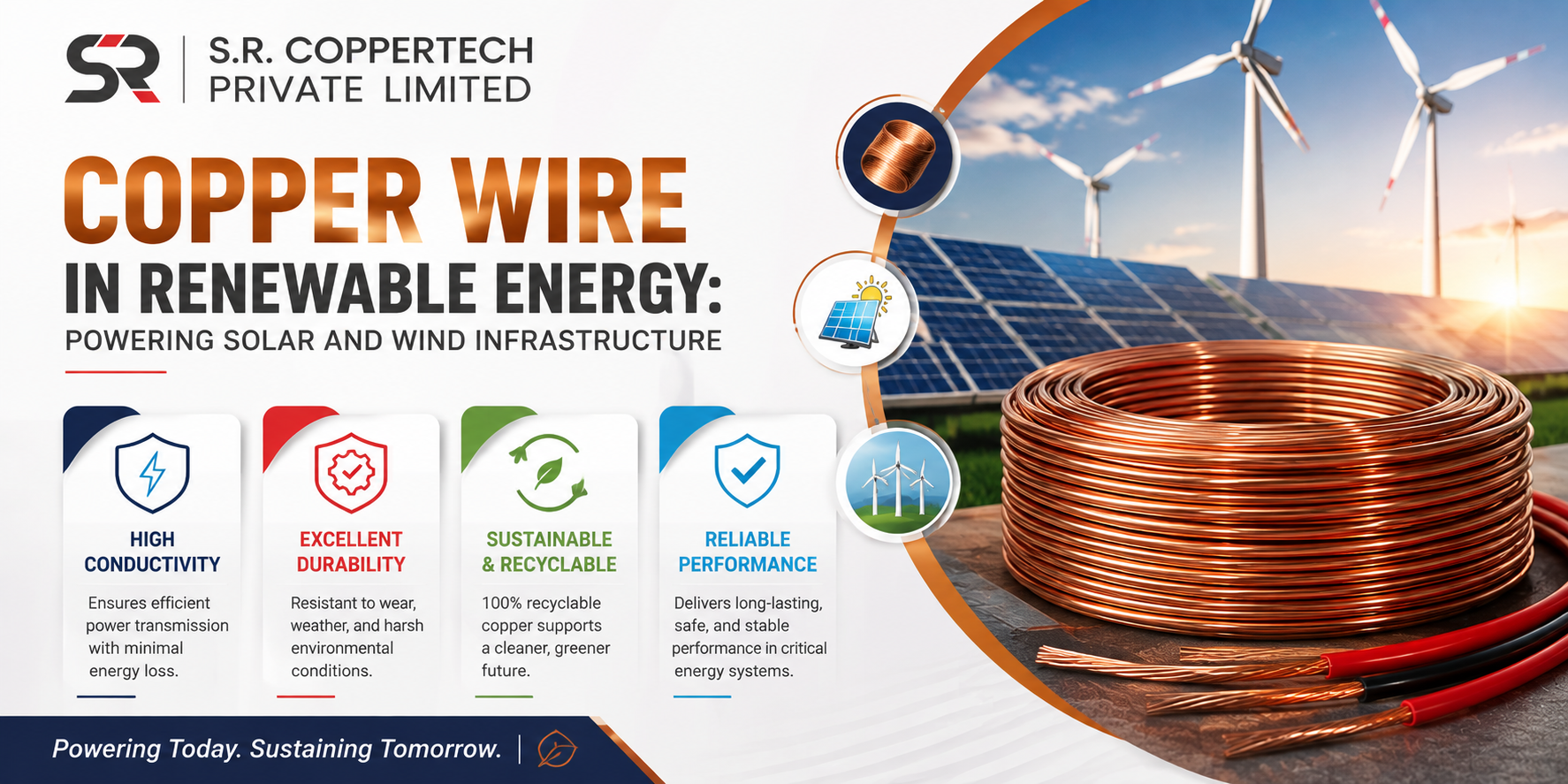
Copper Wire in Renewable Energy: Powering Solar and Wind Infrastructure

Home    Blog     Copper Wire in Renewable Energy: Powering Solar and Wind Infrastructure
Copper Wire in Renewable Energy Solar and Wind Infrastructure
 

By admin / 12 Aug 2026

The global transition toward clean energy is accelerating at an unprecedented pace. As nations and corporations align to achieve net-zero carbon targets, solar and wind power have emerged as the primary pillars of the modern green economy. However, generating power from sun and wind requires sophisticated hardware capable of capturing, converting, and transmitting energy with minimal loss.

At the center of this energy revolution lies a critical industrial material: high-purity copper.

Renewable energy systems are significantly more copper-intensive than conventional fossil-fuel power plants. According to the International Renewable Energy Agency (IRENA) and the International Copper Association (ICA), solar photovoltaic (PV) and wind energy installations require 4 to 6 times more copper per megawatt of installed capacity than traditional coal or natural gas generation.

As a leading manufacturer of high-conductivity copper products, S.R. COPPERTECH PRIVATE LIMITED plays an essential role in supplying the industrial-grade copper wire, busbars, and custom conductors needed to build resilient clean energy infrastructure.

Why Copper is the Material of Choice for Clean Energy

To understand why copper is irreplaceable in green tech, one must look at its physical, chemical, and electrical properties:

  • Superior Electrical Conductivity: Copper boasts the highest electrical conductivity of any non-precious metal. Its low electrical resistance directly minimizes energy loss—known as I2R resistive heating losses—during transmission, ensuring that maximum generated power reaches the end-user.
  • Exceptional Thermal Management: Renewable installations operate under extreme environmental conditions. Copper efficiently dissipates heat, preventing thermal breakdown in high-temperature solar arrays and heavily loaded wind turbine generators.
  • Corrosion Resistance: Solar farms in humid or desert climates and offshore wind turbines in salt-heavy marine environments demand materials that resist oxidation. Copper naturally forms a protective patina, guaranteeing operational integrity over 25+ year lifecycle spans.
  • Ductility and Tensile Strength: Flexible stranded and bunched copper wires resist dynamic mechanical stress, vibration, and torsion—critical factors for turbine nacelles that rotate continuously.
  • 100% Recyclability: Copper can be recycled repeatedly without any loss in performance, aligning perfectly with the circular economy goals of the renewable sector.

Copper Wire in Wind Turbine Infrastructure

Wind turbines operate in harsh engineering environments, from gusty onshore corridors to corrosive marine offshore sites. High-performance copper wire is essential to withstand continuous mechanical strain and harsh climate conditions across three critical areas:

  • Generator Windings: Located in the nacelle, the generator relies on high-grade Oxygen-Free High Conductivity (OFHC) copper wire tightly wound into stator and rotor coils. Copper’s low resistance minimizes heat loss and maximizes electromagnetic efficiency during kinetic-to-electric energy conversion.
  • Flexible Tower Cabling: As the nacelle rotates (yaws) to face changing winds, internal tower cables endure severe torsional twisting. Specialized stranded copper bunching wires provide the necessary flexibility to prevent fatigue, cracking, and cable failure over millions of rotation cycles.
  • Offshore Collector Networks: Submarine power networks use heavy-gauge insulated copper cables to transport high-voltage AC or DC power back to onshore substations. Copper offers superior electrical conductivity and natural resistance to saltwater corrosion and biofouling.

Frequently Asked Questions (FAQs)

1. Why is copper preferred over aluminum for wind turbine generators?

Copper offers superior electrical conductivity (100% IACS compared to aluminum's ~61% IACS), allowing generator coils to carry more current in a smaller space. This higher power density reduces generator size and weight inside the elevated nacelle while minimizing energy loss as heat.

2. How do internal wind turbine cables handle constant rotational stress?

Turbine cables hanging in the tower drip loop use fine-stranded bunching copper wires paired with flexible, abrasion-resistant insulation. Unlike solid conductors, fine copper strands shift independently, allowing the cable to twist repeatedly during yaw maneuvers without work-hardening or cracking.

3. What role does S.R. COPPERTECH PRIVATE LIMITED play in supplying wind energy manufacturers?

S.R. COPPERTECH PRIVATE LIMITED manufactures high-purity copper rods, flexible copper bunching wires, and custom busbars engineered specifically to meet the strict conductivity, tensile strength, and flexibility specifications required for renewable energy infrastructure. .

Copyright © 2026 S.R. COPPERTECH PRIVATE LIMITED

fix-btn