

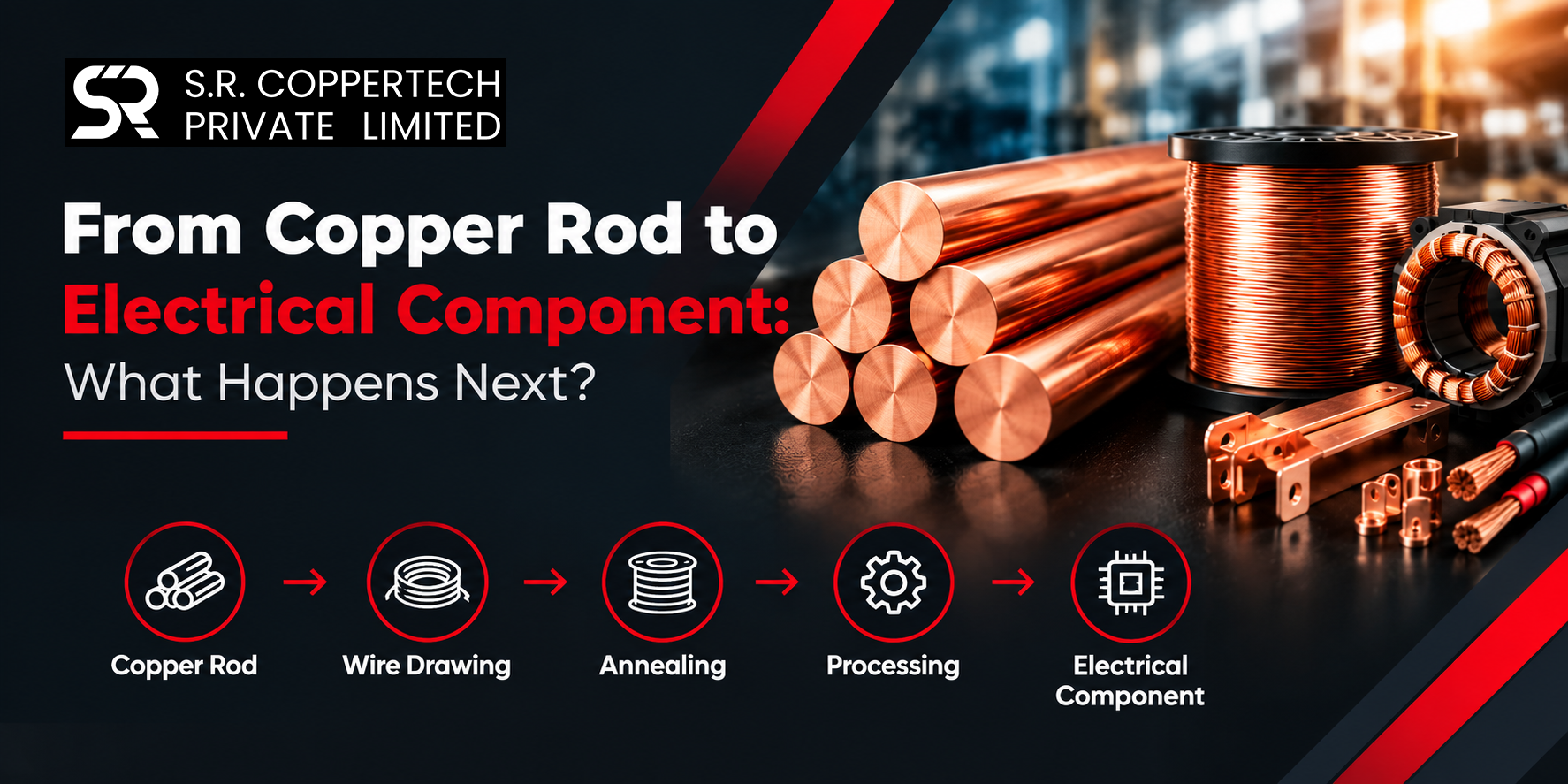
The journey begins with selecting a copper rod that matches the requirements of the final component. Grade, conductivity, dimensions and material quality are some of the factors considered before processing begins.
Fire Refined High Conductivity Copper Rods are used in applications where good electrical conductivity is required. The choice of rod depends on what the finished product needs to achieve and how the material will be processed further.
A suitable starting material can make the following manufacturing stages easier and help maintain consistency in the finished product.
Once the required rod is selected, it may need to be prepared for the next stage. The surface and dimensions are checked according to the requirements of the manufacturing process.
The rod may then be cut, drawn, formed or processed in another way depending on the final application. Different electrical products require different shapes, sizes and levels of flexibility, so the processing method is selected accordingly.
This stage is important because even a small difference in dimensions can affect how the material fits into the final component.
Copper is a relatively workable material, which allows manufacturers to process it into different forms. Drawing is commonly used when a copper rod needs to be converted into a smaller diameter for further use.
During this process, the material is passed through a series of dies to reduce its size. Depending on the product, additional forming or fabrication steps may also be required.
The final dimensions are determined by the component in which the copper will be used. A conductor, electrical connection and other copper-based parts may each have different dimensional requirements.
After processing, the copper can become part of a finished electrical product. Depending on the application, it may be used for conductors, wires, connections and other current-carrying components.
Electrical equipment requires these parts to carry current efficiently while fitting correctly within the overall design. This is why properties such as conductivity, dimensions and material consistency need to be considered from the beginning.
High Conductivity Copper Rods can serve as a starting material for applications where electrical conductivity is an important requirement.
Processed copper finds use across a wide range of electrical and industrial applications. Power generation and distribution equipment rely on copper components for carrying electrical current. Electrical machinery, cables, transformers and other equipment may also include copper parts.
The material is also useful in electronics and industrial manufacturing. The exact application depends on the component design, required electrical properties and manufacturing process.
As electrical systems continue to become more complex, manufacturers need copper materials that can meet the requirements of their particular application.
The final performance of an electrical component does not depend only on its last manufacturing stage. The quality of the starting material also plays an important role.
A copper rod with suitable conductivity, grade and dimensions gives manufacturers a dependable base for further processing. Proper selection can help maintain consistency as the material moves through drawing, forming and other production stages.
For this reason, selecting an experienced supplier of Fire Refined High Conductivity Copper Rods can be an important part of planning an electrical manufacturing process. The required specifications should be discussed clearly before the material is ordered.
A copper rod passes through more than one stage in its process to become part of an electrical component. From selecting the appropriate material and preparing its surface to drawing, forming and final use, each step contributes to the finished product. S.R. Coppertech Private Limited is a supplier of copper products for electrical and industrial use. Discuss copper rod specifications with our team and determine the appropriate material for use in the application.
Copper rods can be processed into wires, conductors and other electrical components.
Good conductivity helps copper carry electrical current efficiently.
It may be drawn, formed, cut or processed according to the requirements of the final product.
Copyright © 2026 S.R. COPPERTECH PRIVATE LIMITED
Powered by : #1 Vinayak InfoSoft - SEO Company Ahmedabad