

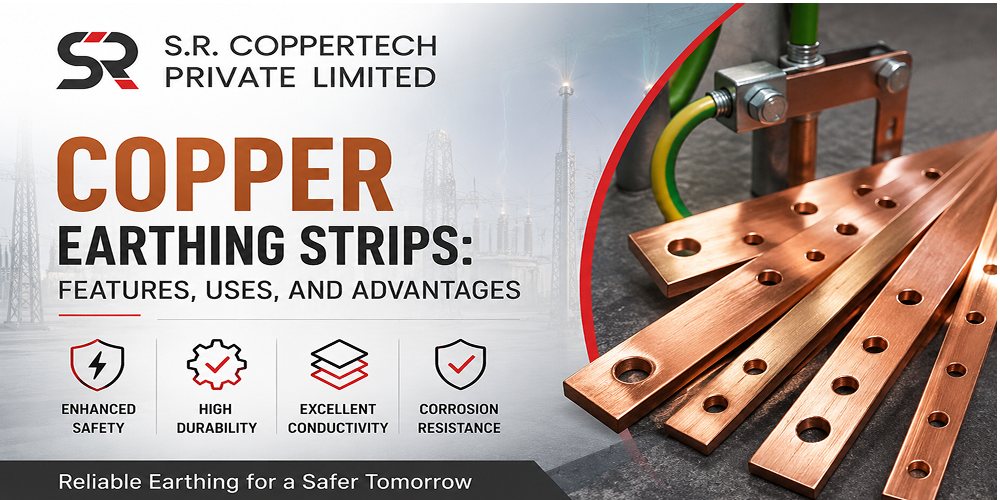
The Ultimate Guide to Copper Earthing Strips: Features, Uses, and Advantages

Home    Blog     The Ultimate Guide to Copper Earthing Strips
Copper Earthing Strips

By admin / 09 July 2026

In electrical engineering and structural safety, earthing (or grounding) is non-negotiable. Whether it’s a sprawling industrial complex, a data center, or a residential high-rise, an effective earthing system is the silent guardian that protects lives, appliances, and infrastructure from catastrophic electrical faults.

At the heart of a robust grounding system lies the earthing conductor. While various materials like galvanized iron (GI) and aluminum are used, copper earthing strips stand out as the premium, gold-standard choice for engineering professionals globally.

Features of Copper Earthing Strips

  • High Electrical Conductivity: Offers an exceptional conductivity rating (100% IACS), ensuring fault currents find the fastest path of least resistance to the ground.
  • Superior Corrosion Resistance: Naturally resists rust and degradation caused by moisture, acids, and chemicals in the soil, ensuring a long underground life.
  • Excellent Thermal Stability: With a high melting point of around 1,085°C, it can handle massive heat generated during a lightning strike or short-circuit without warping or melting.
  • Great Flexibility & Ductility: Highly malleable and easy to bend, shape, and route around corners during installation without cracking.
  • Low Impedance (Flat Design): The flat, rectangular shape provides a higher surface area, which helps dissipate high-frequency lightning surges much faster than round wires.
  • Long Operational Lifespan: A "fit-and-forget" solution that easily lasts 30 to 50+ years with virtually zero maintenance.

Key Applications: Where are Copper Earthing Strips Used?

  • Substations & Power Plants: Grounding generators, transformers, and heavy machinery to prevent electrical surges from causing catastrophic failures.
  • Industrial Manufacturing Units: Safe discharge paths for heavy-duty manufacturing equipment, control panels, and automation grids.
  • Data Centers & Telecom Towers: Crucial protection for highly sensitive servers, switches, and signal antennas against electrostatic discharge.
  • Residential & Commercial Buildings: Used in foundations, electrical service panels, and elevator wells to ensure occupant safety.
  • Solar & Wind Energy Farms: Providing low-resistance grounding networks for solar photovoltaic arrays, inverters, and wind turbine towers.

Major Advantages of Copper Earthing Strips over Alternatives

1. Unmatched Corrosion Resistance

Soil can be highly corrosive due to moisture, salts, and varying pH levels. While GI strips rely on a thin zinc coating that eventually wears away—leaving the underlying iron to rust—copper naturally forms a protective oxide layer (patina) that preserves the metal underneath. It thrives even in damp, acidic, or saline soil conditions.

2. Low Impedance and the "Skin Effect"

Lightning surges behave like high-frequency alternating currents (AC). Due to a phenomenon known as the Skin Effect, high-frequency currents tend to travel along the outer surface of a conductor rather than its core. The flat, wide geometry of a copper strip provides significantly more surface area than a round wire of the same cross-sectional mass, resulting in much lower impedance and faster dissipation.

3. Long Operational Lifespan

A well-installed copper earthing system can easily last 30 to 50+ years without requiring replacement. This "fit-and-forget" nature is vital because grounding systems are buried underground or encased in concrete, making maintenance or replacement incredibly difficult and expensive.

4. Reduced Cross-Sectional Area Requirement

Because copper is roughly three times more conductive than galvanized steel, you can use a much smaller, lighter copper strip to achieve the exact same electrical performance as a bulky steel alternative. This makes installation easier and saves physical space in tight cable trenches.

FAQs for Copper Earthing Strips

Q1: Why is copper preferred over Galvanized Iron (GI) for earthing? +

Copper has significantly higher electrical conductivity and superior corrosion resistance compared to GI. While GI strips rust over time as their zinc coating degrades, copper forms a protective layer that lasts for decades, making it a safer and more reliable choice for critical infrastructure.

Q2: What is the standard thickness and width of a copper earthing strip? +

Standard sizes vary depending on the fault current requirements of the project. Commonly used dimensions range from 20 x 3 mm to 50 x 6 mm (Width x Thickness).

Q3: How long do copper earthing strips last underground? +

Due to copper's natural resistance to soil chemistry and moisture, a high-quality copper earthing strip can easily last between 30 to 50+ years with virtually no maintenance.

Q4: Why are earthing strips flat instead of round wires? +

Flat strips have a higher surface-area-to-volume ratio. High-frequency currents (like lightning strikes) travel along the outer "skin" of a conductor. The flat design provides a larger surface area, which lowers impedance and dissipates dangerous surges into the ground much faster.

Q5: Can copper earthing strips be used in highly acidic or saline soil? +

Yes. Copper performs exceptionally well in harsh environments. However, in extremely aggressive soils, manufacturers often recommend tinned copper strips (copper coated with a thin layer of tin) for an extra layer of protection against severe corrosion.

Copyright © 2026 S.R. COPPERTECH PRIVATE LIMITED

fix-btn